
Page Contents
Dementia is no longer a rare condition confined to advanced old age, as healthcare workers in nursing homes are now seeing residents presenting at younger ages, often in their 60s or even earlier, which reflects both improved detection and changing risk profiles. While age remains the strongest risk factor, dementia is not a normal part of ageing, and its growing prevalence has turned it into a daily reality for caregivers across long-term care settings.
In many facilities, especially those relying on foreign care staff, communication becomes one of the most difficult aspects of care, as language, culture, and cognitive decline intersect.
A rising public health challenge
Dementia represents a significant and growing global health burden, with around 57 million people living with the condition worldwide in 2021, and nearly 10 million new cases diagnosed each year. This number is projected to rise sharply to 78 million by 2030 and 139 million by 2050, driven largely by ageing populations and increased life expectancy. More than 60 percent of cases occur in low- and middle-income countries, where resources for long-term care are often limited. On a global scale, someone develops dementia every three seconds, which highlights the urgency of strengthening care systems and improving communication strategies within nursing homes and community settings.
Challenges in managing elderly with dementia
Caring for persons with dementia extends beyond physical care, as behavioural and communication difficulties often become the main source of stress for caregivers.
Common challenges include:
- Language barriers, especially when caregivers are foreigners and residents revert to their native dialects
- Behavioural symptoms, such as agitation, wandering, shouting, or resistance to care
- Misinterpretation of needs, where pain, hunger, or discomfort is expressed as aggression
- Short attention span, making instructions difficult to follow
- Emotional volatility, including fear, suspicion, or withdrawal
In practice, communication breakdown often leads to escalation, which increases caregiver burden and reduces quality of care.

Why do persons with dementia behave this way?
To communicate effectively, one must first understand the underlying changes in the brain, as dementia affects multiple cognitive domains in a progressive manner. Memory loss, particularly short-term memory impairment, leads to repeated questions and confusion, while language impairment makes it difficult for individuals to find the right words or understand what is being said to them.
At the same time, reduced processing ability means that even simple instructions can become overwhelming, and loss of judgement affects behaviour and decision-making in daily situations. In addition, perceptual changes may cause familiar environments to appear unfamiliar or even threatening, which can trigger fear or agitation.
As a result, behaviours that are often labelled as “difficult” are usually expressions of unmet needs or distress, rather than intentional resistance, and the person is responding in the only way their condition allows.
Why communication matters
Effective communication is central to dementia care, not optional. Effective communication can lead to:
- Agitation reduces, as the person feels understood
- Care compliance improves, including feeding, bathing, and medication
- Risk decreases, especially for falls and aggressive incidents
- Dignity is preserved, which is essential in long-term care
- Caregiver stress reduces, leading to better staff retention
In contrast, poor communication often leads to restraint use, overmedication, and conflict, all of which compromise care quality.
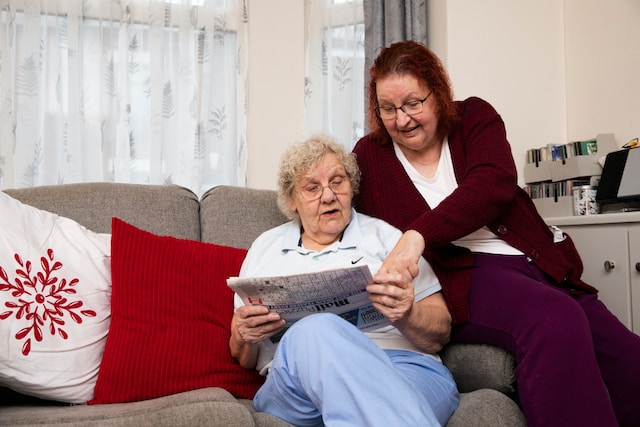
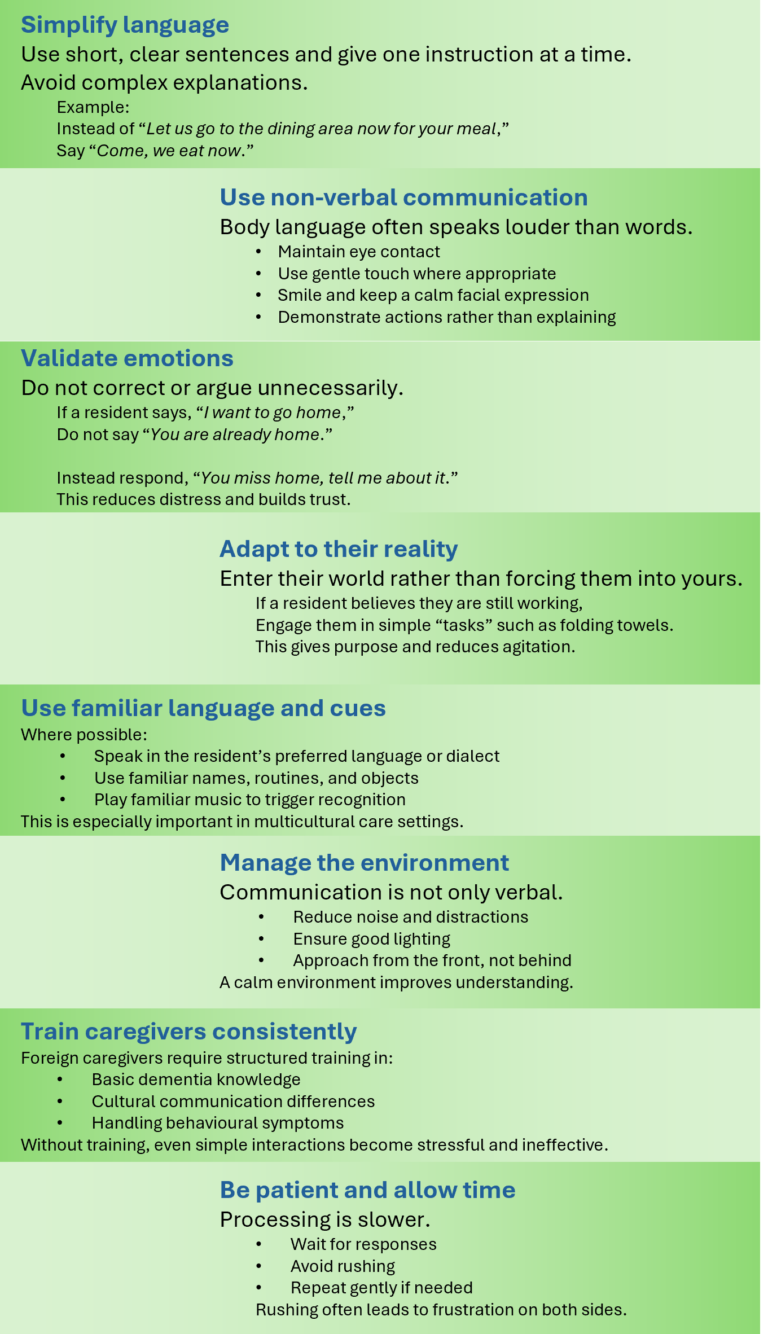
Methods and approaches to communication
There is no single method that works for all residents, but several principles consistently improve outcomes.
Conclusion: Seek first to understand
Communication with persons living with dementia requires a shift in mindset, as success does not depend on correcting the patient, but on understanding their experience. When caregivers focus on the person behind the condition, behaviour becomes more predictable, care becomes smoother, and dignity is preserved.
In dementia care, the question is not “Why are they behaving like this?”, but rather “What are they trying to tell us?”.