
Page Contents
Home care refers to health, personal care, rehabilitation and support services provided in a person’s own home. It allows older adults and people with care needs to receive appropriate assistance without having to move into a nursing home or travel frequently to healthcare facilities.
Home care is an important part of ageing in place. The aim is not simply to keep someone at home, but to help the person remain safe, independent and connected to the community for as long as possible.
Where is home care common?
Home care is well developed in many ageing societies, including Japan, the Netherlands, Denmark, the United Kingdom, Australia and Singapore. OECD data show that home-based care accounts for a large proportion of long-term care in many member countries.
Several factors have encouraged this development:
- More people are living into their 80s and 90s.
- Many older people prefer to remain in familiar surroundings.
- Families are smaller and adult children may be working or living separately.
- More healthcare and rehabilitation can now be delivered safely at home.
- Governments are trying to strengthen community care and reduce unnecessary institutionalisation.
Singapore is also expanding home and community care as part of its ageing strategy, supporting seniors to live independently in the community.
What services does home care provide?
Home care can cover a wide range of services depending on the person’s needs.
- Nursing care may include wound care, monitoring vital signs, feeding-tube or catheter care, chronic disease monitoring and caregiver education.
- Medication support can include checking what medicines the person is taking, identifying discrepancies after hospital discharge, helping with medication routines and referring concerns to doctors or pharmacists.
- Rehabilitation may involve physiotherapy and occupational therapy to improve strength, balance, walking and daily activities. A major advantage is that therapists can work with the person in the actual home environment.
- Personal care can include:
- Showering and dressing
- Toileting
- Feeding
- Grooming
- Transfers between bed and chair
- Other services may include meal delivery, housekeeping, medical escort, transport and caregiver support.
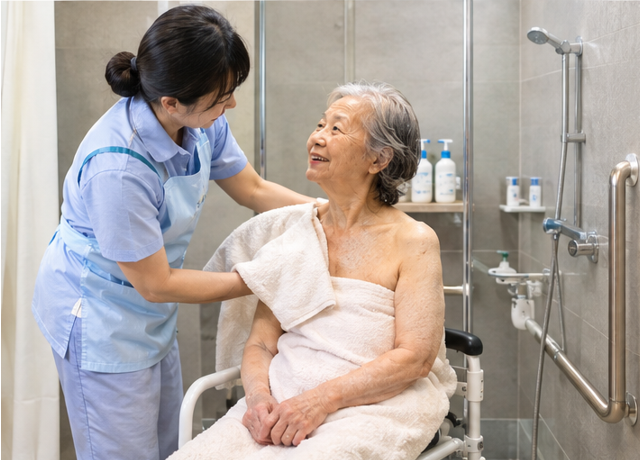
The exact package should depend on the person’s condition and goals rather than providing the same service to everyone.
Who needs home care?
Home care is suitable for a broad range of people, including:
- Older adults with frailty or reduced mobility.
- People with chronic diseases who need regular monitoring.
- Individuals recovering from surgery, stroke, fractures or hospitalisation.
- People living with dementia.
- Older adults who need help with daily activities.
- People receiving palliative or end-of-life care.
- Family caregivers who need professional assistance and respite.
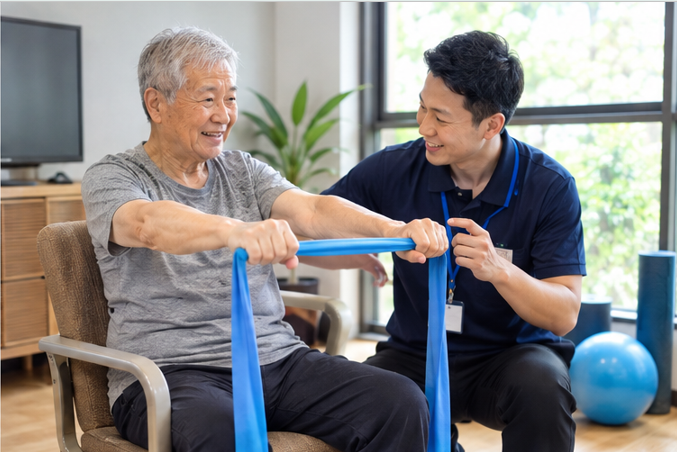
Importantly, home care is not only for people who are severely disabled. It can also provide short-term support during recovery or help prevent a gradual decline in independence.
What are the benefits?
The greatest advantage is that care is provided in a familiar environment.
Home care can help older people:
- Remain in their own home for longer.
- Maintain independence and daily routines.
- Receive rehabilitation using their actual home environment.
- Avoid unnecessary travel to healthcare facilities.
- Receive earlier attention when their condition changes.
- Maintain relationships with family, friends and the community.

It can also support family caregivers. Instead of one family member trying to manage everything alone, professional care can become part of a wider support network.
However, good home care should not mean doing everything for the older person. Whenever safe and possible, the person should continue to participate in their own care. The principle should be “do with, not do for.“
What challenges do home-care teams face?
Providing care in someone’s home is very different from working in a hospital or nursing home. The home may have narrow spaces, poor lighting, unsafe bathrooms, clutter or other hazards. Care workers may also work alone and have limited access to immediate assistance.
Other challenges include:
- Travelling between multiple clients.
- Coordinating doctors, nurses, therapists and family members.
- Managing unexpected changes in a client’s condition.
- Different expectations between the client and family.
- Workforce shortages and staff turnover.
- Maintaining privacy and professional boundaries in the client’s home.
Communication is particularly important. Without good coordination, the older person may receive several services without anyone having a clear picture of the overall situation.
How can we improve home care?
Home care should become more person-centred, coordinated and outcome-focused.
Assess the whole person
Assessment should consider not only medical conditions but also mobility, cognition, nutrition, medication, home safety, social support and caregiver capacity.
Set meaningful goals
Instead of simply saying “three home visits per week”, the care plan should identify what the person wants to achieve. For example:
- Walking safely to the toilet.
- Preparing a simple meal.
- Showering with less assistance.
- Returning to the nearby coffee shop.
- Remaining safely at home.
Improve continuity
Whenever possible, clients should see a familiar group of care professionals. Continuity builds trust and allows staff to notice small changes in the person’s condition.
Strengthen care coordination
A care coordinator can connect the client, family, doctor, nurse, therapist and social services so that everyone is working towards the same goals.
Use technology wisely
Fall detectors, telehealth, remote monitoring and medication reminders can improve safety and efficiency. However, technology should support human care, not replace it. A sensor can detect that someone has fallen, but a person still needs to respond, assess the situation and provide reassurance.
Measure what matters
Client satisfaction should go beyond asking whether staff were polite. Providers should also ask whether the client feels safer, more independent and better able to do the things that matter to them.
Conclusion
Home care is becoming increasingly important as societies age and more people choose to remain in their own homes.
Good home care is not simply about sending a nurse or caregiver to someone’s house. It is about understanding the person’s needs, preserving independence, supporting the family and bringing the right services together at the right time.
The ultimate goal is simple: Do not just help older people stay at home. Help them continue to live well at home.
Caring for our ageing loved ones is a journey filled with questions, challenges, and important decisions. If you are supporting an elderly parent or caring for someone with memory loss, you may be interested in my ebooks:
- When They Need You
- When the Mind Fades
- When the Pills Multiply
- When the Road Narrows
- When the Body Slows Down
These ebooks provide practical guidance, compassionate insights, and real-world advice for families and caregivers.

To learn more about these books and explore additional resources on ageing and eldercare, click the link Here to visit my ebook page. You do not have to navigate the ageing journey alone.