
Page Contents
CCTV is already an important security and safety tool in many eldercare facilities. Cameras are commonly used in areas such as:
Main entrances and exits
Reception areas
Corridors and common areas
Carparks
Kitchens
Multipurpose halls
Lifts and lift lobbies
Other higher-risk or public areas
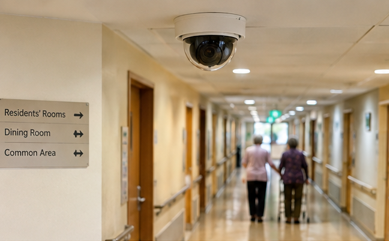
These cameras can help deter unauthorised entry, investigate accidents, identify security incidents and provide information when something goes wrong. CCTV therefore has a legitimate place in eldercare.
The question becomes much more complicated when the camera moves from the corridor to the resident’s bed.
Why is the bed area different?
A resident’s bed area is not simply another part of the facility. It is where a person sleeps, changes clothes, receives personal care, interacts with family and sometimes spends the final stage of life.
Traditionally, routine CCTV surveillance has therefore been kept away from highly private areas such as bedrooms, bathrooms and examination areas.
Internationally, care regulators have recognised that surveillance may sometimes be appropriate in private rooms, but emphasise necessity, proportionality, privacy, consent and transparency. The UK’s Care Quality Commission, for example, requires providers to consider less intrusive alternatives and to involve residents and families in decisions about surveillance.
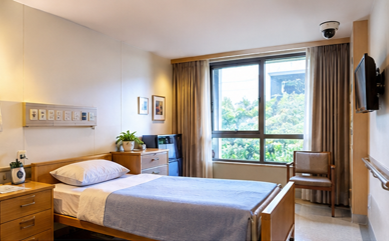
The distinction is important, a camera in a corridor watches an environment; a camera beside someone’s bed watches a person.
Why install cameras near residents’ beds?
There are genuine reasons why a nursing home or family might consider it.
Detecting falls
An older person may fall beside the bed and be unable to reach the call bell. A camera or vision-based monitoring system could potentially detect unusual movement or a person lying on the floor and alert staff. This could be particularly useful for residents with high fall risk.

Detecting prolonged immobility
A resident may suddenly become unresponsive, remain in an unusual position or stop moving. Technology could potentially identify these changes and trigger a regular check.
Safeguarding against abuse or neglect
CCTV may provide evidence when there are concerns about inappropriate care, rough handling or other forms of abuse. It can also protect staff by providing an objective record when an allegation is made.
Understanding what happened
When an incident occurs, staff often have to reconstruct what happened from incomplete information. A recording may help answer questions such as:
- Did the resident fall or deliberately get out of bed?
- How long had the resident been on the floor?
- Who entered the room?
- What happened before the incident?
- Was assistance provided?
Reassurance for families
Some family members may feel more comfortable knowing that their loved one’s safety can be monitored. However, reassurance is not automatically a sufficient reason to install a camera. The benefit to safety must be balanced against the resident’s right to privacy.
What are the disadvantages?
Privacy and dignity
This is the most obvious concern. Imagine being an older person who knows that a camera is watching while sleeping, changing clothes or receiving personal care. Even if nobody is actively watching the screen, the knowledge that the footage exists may change how the person feels about their own room. A resident’s room should remain a place where the person can retain a sense of privacy and ownership.
The resident may feel constantly watched
Safety should not come at the cost of making someone feel like a prisoner. For a cognitively intact resident, being monitored continuously may feel intrusive. For a person living with dementia, the situation can be even more complicated because they may not fully understand why a camera is present.
Family concerns
Next-of-kin may have different views. One daughter may say: “I want a camera because I want to know that Mum is safe.” Another family member may say: “I don’t want anyone watching Mum while she is sleeping or receiving personal care.” Both concerns can be genuine and complicated, especially when residents are sharing rooms.
Staff privacy
The camera does not only record the resident. It records nurses, care staff, therapists, doctors, domestic staff, visitors and other residents who may enter the room. The footage therefore contains information about many people.
Cybersecurity and unauthorised access
A camera connected to the internet creates another potential vulnerability.
- Who has the password?
- Can footage be downloaded?
- Can it be viewed remotely?
- How long is it stored?
- What happens if an employee leaves the organisation?
- What happens if the system is hacked?
CCTV footage containing identifiable individuals is personal data, and organisations using CCTV must consider notification, lawful collection, protection, access and disclosure requirements.
Cameras may create false reassurance
This is another important concern. A camera does not automatically mean that someone is watching, a staff member may not notice an alert, an AI system may miss a fall, a camera may not capture the relevant angle. Technology can fail. Therefore, CCTV should never become an excuse to reduce appropriate staffing, observation or human contact.
How can we reduce the risks?
The answer is not necessarily to choose between “camera” and “no camera”. There is a middle ground.
Use the least intrusive technology
Before installing a video camera, ask whether the same safety objective can be achieved through:
- Bed-exit sensors
- Movement sensors
- Pressure sensors
- Wearable alert devices
- Fall-detection technology
- Regular welfare checks
If a sensor can detect that someone has fallen without recording the person’s body, it may provide a better balance between safety and privacy.
Avoid unnecessary audio
Audio surveillance is considerably more intrusive because it can capture private conversations. If the purpose is fall detection, there may be little justification for recording conversations as well.
Position cameras carefully
The camera should capture only what is necessary. For example, the objective may be to monitor the space around the bed rather than the entire room. The camera should not unnecessarily capture bathrooms, changing areas or intimate care.
Consider “privacy zones”
Technology can sometimes be configured to obscure particular parts of the room or automatically blur sensitive areas. This follows an important principle: Collect the minimum information necessary to achieve the safety objective.
Give residents a choice where possible
A resident who has mental capacity should be involved in the decision. Explain:
- Why the camera is being proposed
- What it will record
- When it will operate
- Who can view it
- Whether it records continuously
- How long recordings are kept
- When footage may be shared
- How the resident can raise concerns
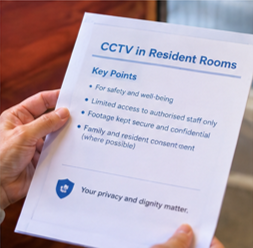
Consent should not become a one-time signature that disappears into a file. It should be part of an ongoing conversation.
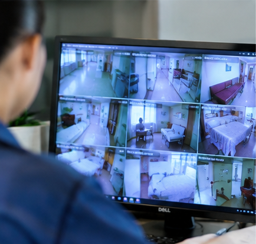
Establish strict access controls
Not every staff member should be able to watch or download footage. There should be clear rules about:
- Who can access live images
- Who can retrieve recordings
- When footage can be reviewed
- Who can authorise access
- How access is logged
- How long footage is retained
- How footage is securely deleted
What should a nursing home consider before installing CCTV at bed areas?
Before purchasing a camera, the organisation should ask a more fundamental question: “What problem are we trying to solve?”
A proper assessment could consider:
1. Purpose
Is the objective fall prevention, safeguarding, wandering prevention, clinical observation or investigation of a specific concern? The purpose should be clearly defined rather than installing cameras simply because the technology is available.
2. Necessity
Could the same objective be achieved without video? If a motion sensor can provide adequate information, a camera may not be necessary.
3. Proportionality
Does the safety benefit justify the intrusion into privacy? The greater the intrusion, the stronger the justification should be.
4. Resident preference and capacity
What does the resident want? Can the resident understand the purpose and make the decision? If the resident lacks capacity, the organisation should follow the appropriate legal and ethical framework for decision-making and consider the person’s best interests.
5. Family involvement
Families should be informed and given an opportunity to discuss concerns, particularly when the resident cannot make the decision independently. But family preference should not automatically override the resident’s dignity and rights.
6. Technology and cybersecurity
The organisation should understand where recordings are stored, who can access them and how the system is protected.
7. Operational response
Perhaps the most important question: “What happens when the camera detects a problem?” There is little value in detecting a resident falling at 2am if nobody responds. Technology must be connected to a reliable human response system.
8. Regular review
A resident’s condition can change. A camera that may be justified after a serious series of falls may no longer be necessary months later. The decision should therefore be reviewed rather than becoming permanent surveillance by default.
Conclusion
CCTV can make an eldercare facility safer. It can help detect incidents, investigate accidents, protect vulnerable residents and provide useful information when something goes wrong. But the bed area is different from the reception area or carpark. It is part of a person’s private living space.
The challenge is therefore not to decide whether CCTV is good or bad. The better question is: “Can we achieve the required level of safety with the least possible intrusion into the resident’s privacy?” Sometimes the answer may be a camera. Sometimes it may be a sensor. Sometimes it may simply be better staffing, more frequent observation or a change in the care plan.
The best eldercare system does not choose technology simply because it can be installed. It chooses the right level of technology for the right person, for the right reason, with the right safeguards. Safety matters. But so do privacy, dignity, autonomy and trust. For an older person living in a nursing home, being protected should never mean ceasing to have a private life.
Caring for our ageing loved ones is a journey filled with questions, challenges, and important decisions. If you are supporting an elderly parent or caring for someone with memory loss, you may be interested in my ebooks:
- When They Need You
- When the Mind Fades
- When the Pills Multiply
- When the Road Narrows
- When the Body Slows Down
These ebooks provide practical guidance, compassionate insights, and real-world advice for families and caregivers.

To learn more about these books and explore additional resources on ageing and eldercare, click the link Here to visit my ebook page. You do not have to navigate the ageing journey alone.